An article in the Wiltshire Archaeological and Natural History Magazine of 1920 summarised Roman finds near Purton, Wiltshire. It mentions the discovery of a probable Roman villa in Victorian times but then goes on to say “This find is not to be connected with fragments of mosaic of glass said to have been recently found at this place, which are obviously of foreign make and comparatively modern date.” So, the authors are saying that sometime after the Roman villa was abandoned somebody came along and built a house with a glass mosaic in exactly the same place; this seems highly unlikely.
Glass mosaics are known from other parts of the empire and there is a famous example in Vienne in France. There are also some examples of glass being used in mosaics much closer to home. The Corinium museum in Cirencester (about 12 miles from Purton) has several mosaics from Roman Cirencester. The hare mosaic which is displayed prominently near the entrance to the museum has glass tesserae along the back of the hare, and the seasons mosaic has glass tesserae in two different panels. The head of Flora, representing spring, has tesserae of red glass in her hair. When first discovered the tesserae were not so vibrant as the red glass had become discoloured with age but when polished the red colour was restored and the red flowers became apparent. Red glass tesserae were also used in the panel showing the hunter Actaeon being attacked by his own dogs. Actaeon had dared to gaze upon the goddess Diana as she bathed. When Diana saw Actaeon she turned him into a stag but his dogs no longer recognised him and attacked him, and this scene is depicted in the mosaic. The blood coming from Actaeon’s leg is depicted with tesserae made of red glass. Clearly there is a local tradition of using glass tesserae in mosaics in the Cirencester area so it is highly likely that the glass mosaic discovered at Purton in the early 20th century was Roman. Cirencester was home to a school of mosaicists who installed mosaics across the region so it is possible that the use of glass in mosaics was more widespread than we currently realise.
So where did these fragments of coloured glass come from? It is generally accepted that there was no primary glass manufacturing in Roman Britain. Raw glass appears to have been imported then re-melted to produce glass items. Fahy noted the correlation between ceramic production sites and glass production sites and both industries require high temperature kilns, sources of fuel and a skilled workforce. If the glass fragments were produced in Britain rather than being imported then Purton would be a possible manufacturing site. Apart from the tile manufacturing site at Minety, it is the closest kiln site to Cirencester and has a similar operational date to the mosaics being produced with glass tesserae. Anderson dated the pottery from the kiln site to the mid 2nd century and Witts says that the seasons mosaic could be dated to the late 2nd century or early third century. Cosh dates it to the 2nd century. It is certainly possible that the dates overlapped. My conclusion is that the “fragments of mosaic of glass” were part of a 2nd century mosaic installed in a Roman villa at Purton. Furthermore, the glass fragments may have been produced at the nearby kilns, only 100m from the villa site.
The siting of the kilns found at Dogridge in 1975 is unusual. Usually, kilns are located on the clay that is used to produce pottery but here the bedrock is limestone. There is a deposit of Ampthill/Kimmeridge clay about 200m to the south but there is no evidence of any clay pits in this area. There are larger deposits a bit further afield and deposits of Oxford clay on lower ground to the north and west, but if they used this clay why didn’t they put the kilns where the clay was? The location away from clay deposits suggests the kilns weren’t used for high volume production. If they had wanted high volume production they would have put the kilns closer to the source.
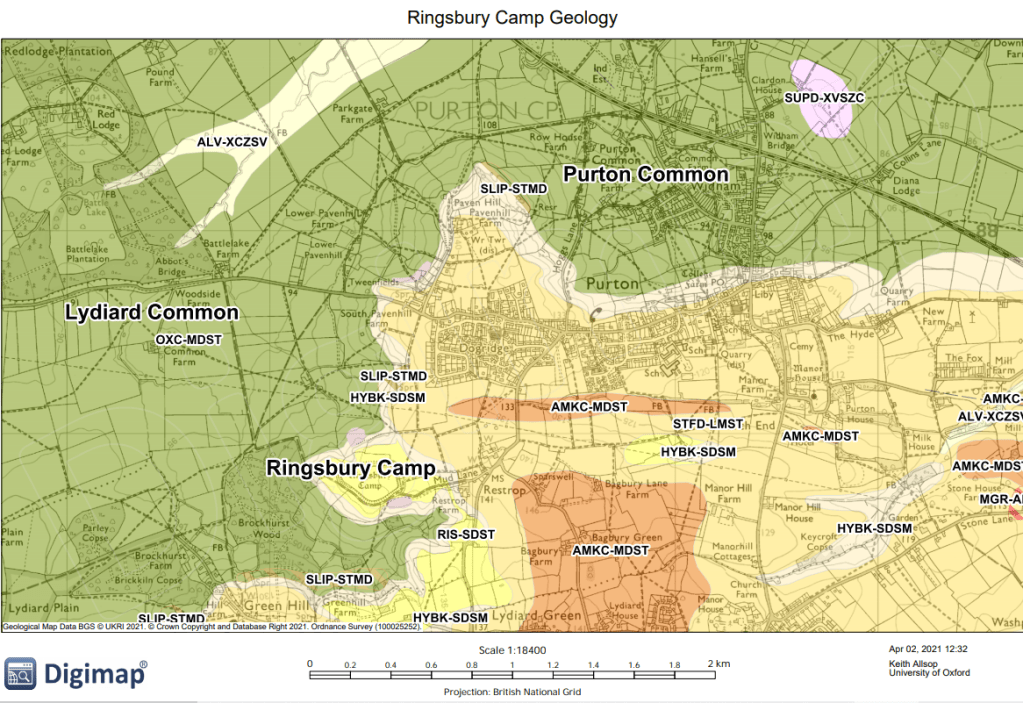
The Purton kilns were discovered during housebuilding. Anderson was able to inspect the kilns but was not able to conduct a proper archaeological investigation before the site was developed. He thought there could be as many as six kilns on the site and noted an unusual kiln design for kiln 1. The flue was almost as wide as the body of the oven. Anderson also noted the presence of unfired clay and potsherds. It is possible that the location of the kilns on higher ground and the wide flue were both designed to increase the airflow through the kiln and produce higher temperatures. The Romans in Purton project dug a test pit about 20 m south-east of the location of the kilns in the HER found no evidence of pottery manufacturing but did find a small piece of slag, “probably related to metalworking” so it is certainly possible that the kilns were used for metal or glass production.
The Romans in Purton project dug test pits in the gardens of volunteers in the Dogridge and Pavenhill areas. Six tesserae were found in the gardens of houses on the opposite side of Pavenhill from the Royal George pub. The tesserae appear not to be cut from fired pottery. They appear to be comparitively small and shaped before firing, with slightly concave faces as would be produce if wet clay was shaped into a cube by fingers. These smaller tesserae were most likely produced to be part of a mosaic with a pictorial design, not simply a geometric pattern. They could also have been produced in the Purton kilns.
References
Anderson, A.S. (1979) The Roman Pottery Industry in North Wiltshire. Thamesdown Borough Council
Buckman and Newmarch, C. H. (1850) Illustrations of the Remains of Roman Art in Cirencester. George Bell, London
Cosh, S. R. (2026) Mosaics in Britannia. Archaeopress, Bicester
Hood, A. (2026) The Romans in Purton Project, Purton, Wiltshire. Foundations Archaeology https://www.purtonmuseumandhistoricalsociety.com/latest-news
Rainey, A (1973) Mosaics in Roman Britain, A Gazetteer. David and Charles, Newton Abbot
Witts, P. (2010) Mosaics in Roman Britain, Stories in Stone. The History Press, Stroud

