A number of changes to agricultural practices took place towards the end of the Anglo-Saxon period. The visible remnants of these changes are the ridges and furrows of the open fields. Ridges in the fields were created by repeatedly ploughing soil into the middle of a ridge. This also created a furrow between the ridges, and the furrows were about 15m apart, with a ridge between. Each strip of ridge and furrow was owned by a household.
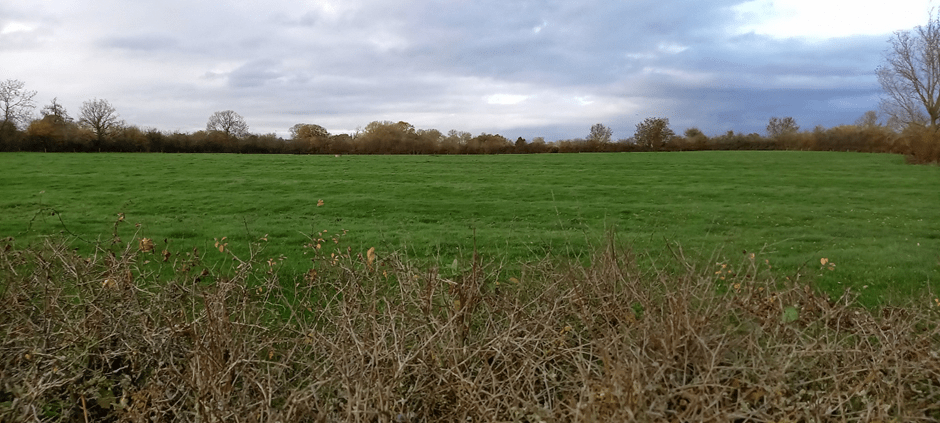
There were usually two or three open fields and crops were rotated around the fields and the rotation also included a year when no crops were planted in one of the fields. The fields were managed co-operatively by the families that farmed them. Villages coalesced around the manor and the church.
The problem we have is that there is very little evidence for the date of these changes. David Stocker in his English Heritage book of the landscape of the East Midlands suggests a date of around 850 based upon the evidence of pottery finds in the open fields and modern villages. Fieldwalking of fields known to be open fields produced some dense scatters of pottery from before 850. These are believed to be the remains of farmsteads that had been moved to make way for the open fields. The open fields had a thin scatter of pottery post-850 these were generally small fragments believed to have come from domestic waste used to manure the fields. Where sites in modern villages have been excavated the amount of pottery increases after about 850.
These changes were revolutionary, having a big impact on the way that people farmed and the way that they interacted with each other. They happened at around the same time across a broad swathe of the country, stretching from Yorkshire down to Dorset, although large areas of the country (Wales, Devon and Cornwall, East Anglia) were unaffected. Despite the magnitude of the changes there is very little documentary evidence for their implementation or existence. Domesday Book contains a few hints that arable farming may have happened in this way but the lack of evidence in Domesday has convinced some that the open fields and ridge and furrow farming must have been introduced after the Norman conquest.
An example of the fragmentary nature of the evidence can be found in a charter of 999 concerning land in South Cerney in south Gloucestershire. After a dispute the king granted the estate of South Cerney to the widow, Eadflaed. The charter describes the boundary of the estate and these seem to agree with the boundary of the modern parish.
The interesting bit is right at the start of the description of the boundary in the north of the parish. In modern English it reads:
Start at Cat’s stone and follow a furrow on the family moor
0n the High Street follow the road to the moot ford
The High Street is Ermine Street which runs diagonally across the top right-hand corner of the image.
At the end of the description of the bounds the charter describes how the route follows the River Churn then back to the Cat’s stone, so the furrow mentioned lies between the River Churn and Ermine Street and lies on the Estate boundary which is also the parish boundary.
The furrow referred to is likely to be the ridge and furrow that can be seen on LIDAR. The furrows align with the parish boundary. (The parish boundary is shown in red and the field with the ridge and furrow is outlined in blue)


David Stocker’s date of 850 for the creation of the open fields came from studies in Leicestershire and Northamptonshire so may not be applicable in South Gloucestershire, but we now have evidence that ridge and furrow here preceded 999.
Notes
The translation of the charter of 999 comes from “Fertile Fields and Small Settlements – A History of South Cerney and Cerney Wick” by Michael Oakeshott
 Before 1066